
Favorite Electric Stim
Programs
Updated Apr 20, 2026
This page pairs well with Electric Stimulation Pad Placements.
The following settings are specifically for the programmable [warning: not all Globus machines are programmable], 4-channel Globus brand electrical stimulation machines.
These settings can be adapted with other brands if you both know what you are doing and if the machine is capable. Most machines are incapable. However, if you only need two channels, the InTENSity Twin Stim 4 can do almost all the Globus can at a fraction of the cost.
Electric stimulation, both EMS (electric muscle stimulation) and TENS (transcutaneous electrical nerve stimulation), is still a debacle, for which, when I get time, a future page will be devoted. However, in short, good machines are not available in the USA, and when they are, their software is disabled (like Globus Sport models), hobbling them so that they can’t run my favorite programs. The very programs I researched in the scientific literature and tested on myself, when I did my year of electric stimulation as total body exercise, notes here. And also what programs I used regularly in my physical therapy practice.
Long story short, the only EMS/TENS machines I currently advocate are the Globus Genesy line. Unfortunately, they’re overpriced, and I think you need a physician’s prescription for the distributor in Florida to send you one. They are awesome, however, so if you can afford one, then it’s worth it, and it’s the machine I used for the latter half of my year.
The Globus Triathlon ordered direct from Europe off eBay is 100% as good and often cheaper than the Genesy, and being a sport rather than a medical model, it does not require a physician’s prescription. Unfortunately, the USA import models have had their programmability feature disabled, thus can’t be made to run my programs. Instead, it comes with preset programs that somebody else thinks are best, but that somebody isn’t me. That said, you can order a fully functional Globus Triathlon direct from Italy or from the UK off eBay for less than the USA import price. I’m not telling anyone to do that, but that’s what my friends do.
The EV-906 is what I used in the beginning of my year. Some of them are good, and they are inexpensive. However, later a new version of the same name and appearance was released that was pitifully weak. So I have no idea whether you would be getting a good one or a bad one.
I absolutely don’t have time to look up the parameters on any given machine a person has or is thinking about getting. Sorry.
As for Compex machines, I loathe them.
Favorite programs are as follows:
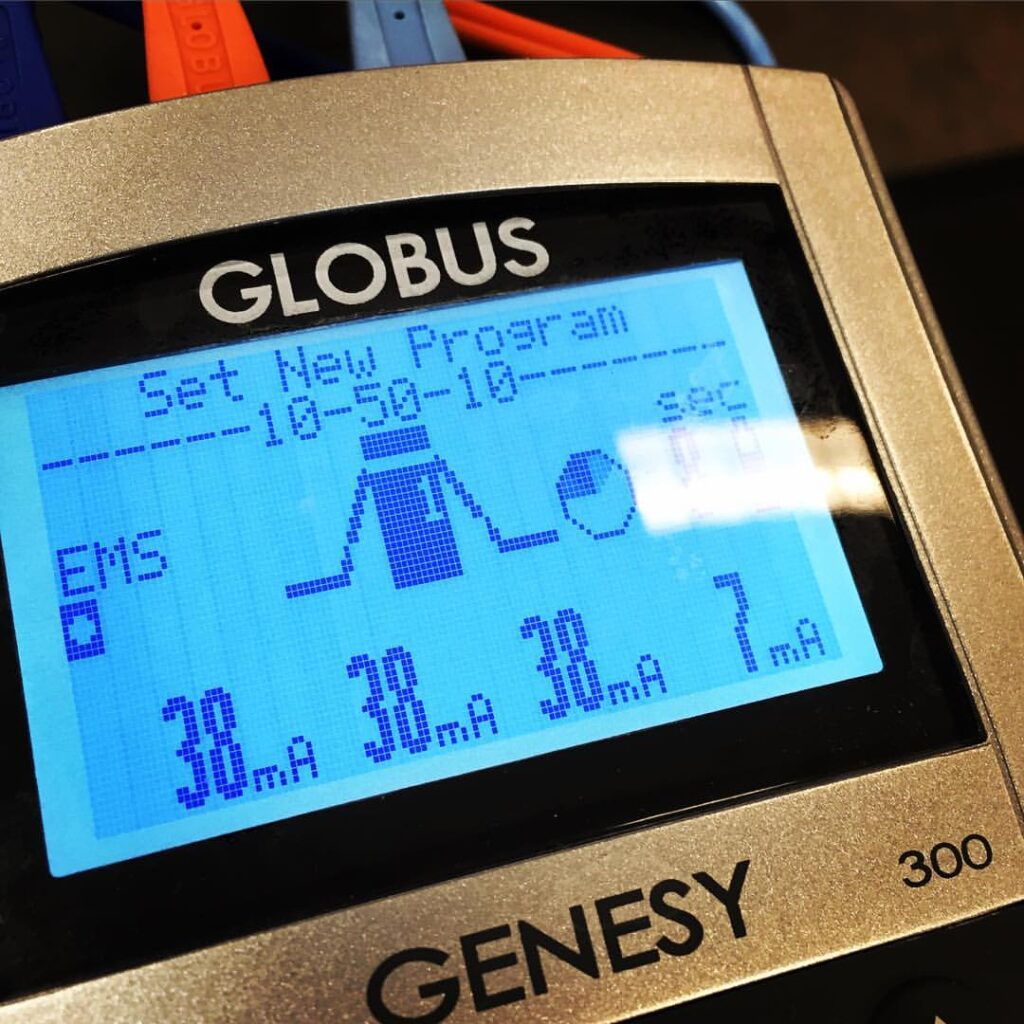
10-50-10 (program name)
- Type of stimulation: EMS
- Number of phases: 1
- Phase duration: 10
- Type of stimulation: Intermittent
- Type of modulation: Constant
- Workout frequency: 60 Hz
- Workout pulse width: 450 uS
- Ramp up duration: 1000 mS
- Workout duration: 10s
- Ramp down duration: 500 mS
- Rest stimulation: type: Constant
- Rest frequency: 5 Hz
- Rest duration: 50 s
Comments
You can see that I like to name my programs so that I can remember what parameters are in them. For example, “10-50-10” means it’s 10 seconds on (of stimulation), 50 seconds of rest, for a total treatment time of 10 minutes.
This has been my “go-to” strength, pain, and almost everything setting for well over a decade. Adapted from the sprint coach Charlie Francis, in his book The Charlie Francis Training System.
Charlie did not have the 5 Hz rest stimulation, but it’s a required input on the Globus machines. However, you can turn the rest stimulation down to zero when in use if you wish, and I sometimes do.
10-10-10 (headache favorite)
- Type of stimulation: EMS
- Number of phases: 1
- Phase duration: 10
- Type of stimulation: Intermittent
- Type of modulation: Constant
- Workout frequency: 120 Hz
- Workout pulse width: 450 uS
- Ramp up duration: 1000 mS
- Workout duration: 10s
- Ramp down duration: 500mS
- Rest stimulation: type: Constant
- Rest frequency: 5Hz
- Rest duration: 10s
Comments
This program is working off the theory that migraine suffering is due to overactive pain receptors. So to fatigue them out faster, a higher duty cycle (greater on-time vs. off-time) is used. The goal here being to fatigue the nerves and thus pain.
Also, the frequency is double at 120 Hz.
Patients loved it! However, 10-50-10 was also effective.
30hz-10
- Type of stimulation: TENS
- Number of phases: 1
- Phase Duration: 10
- Program Name: Symmetric TENS
- Type of modulation: Constant
- Workout freq: 30 Hz
- Workout pulse width: 450 uS
Comments
This is a new one for me that I’m still testing. 30 Hz continuous seems to be the most frequent parameter used in the surgically implanted vagus nerve stimulation research. For some reason that I’ve yet to determine, taVNS most frequently uses 25 Hz continuous.
Anyway, when I try it, the 30 Hz continuous leads to a rapid buildup of lactic acid, and I have to think other metabolites as well, but it is not as fatiguing as you might think (like the 60 Hz I used for 10-50-10). My thoughts (based on trying it and recollecting some papers) are that this might be ideal for angiogenesis (blood vessel growth/recovery) and neurogenesis (nerve growth/recovery).
5hz-10
- Type of stimulation: TENS
- Number of phases: 1
- Phase Duration: 10
- Program Name: Symmetric TENS
- Type of modulation: Constant
- Workout freq: 5 Hz
- Workout pulse width: 450 uS
Comments
TENS programs, unlike EMS, generally do not have an on and off period. Thus there are fewer settings to input, so my naming just denotes the impulses per second (aka “rate” or “Hz”) times the treatment time I program the machine for. In this case, 10 minutes.
5 Hz is, according to my self-testing and in accordance with the research, ideal for increasing blood flow to a region via aerobic-type muscle contractions. Contrary to EMS being more for strength training.
5hz-30
- Type of stimulation: TENS
- Number of phases: 1
- Phase Duration: 30
- Program Name: Symmetric TENS
- Type of modulation: Constant
- Workout freq: 5 Hz
- Workout pulse width: 450 uS
Comments
Same as the above but longer. This is an aerobic workout for whatever muscle you put it on, and if you put it on a large number of big muscles, it can be aerobic for your whole body. While not my preferred form of exercise, it works, and I talked about it here.
fmtens-10
- Type of stimulation: TENS
- Number of phases: 1
- Phase Duration: 10
- Program Name: Symmetric TENS
- Type of modulation: Frequency Modul.
- Start workout freq: 2 Hz
- End workout freq: 80 Hz
- Workout pulse width: 450 uS
- Workout duration: 5 s
Comments
The letters “fm” in this instance stands for “frequency modulated.” If I have a patient with any anxiety about electrical stimulation, this is the program I’ll give them the first time. It’s probably not best for increasing function or decreasing pain, though it’s pretty good for pain. But it is the best I know of for feeling good, while it’s on.
I came up with it one night sitting at home, with my Globus machine on me, programming, and reprogramming, what I thought would feel best. One of my patients, after ten minutes said, “you’re going to put massage therapists out of business with that one.”
fmtens-30
- Type of stimulation: TENS
- Number of phases: 1
- Phase Duration: 30
- Program Name: Symmetric TENS
- Type of modulation: Frequency Modul.
- Start workout freq: 2Hz
- End workout freq: 80 Hz
- Workout pulse width: 450uS
- Workout duration: 5s
Comments
Same as fmtens-10, except 30 minutes.